
Duska talks to Alan
Published 15 Jul 2026
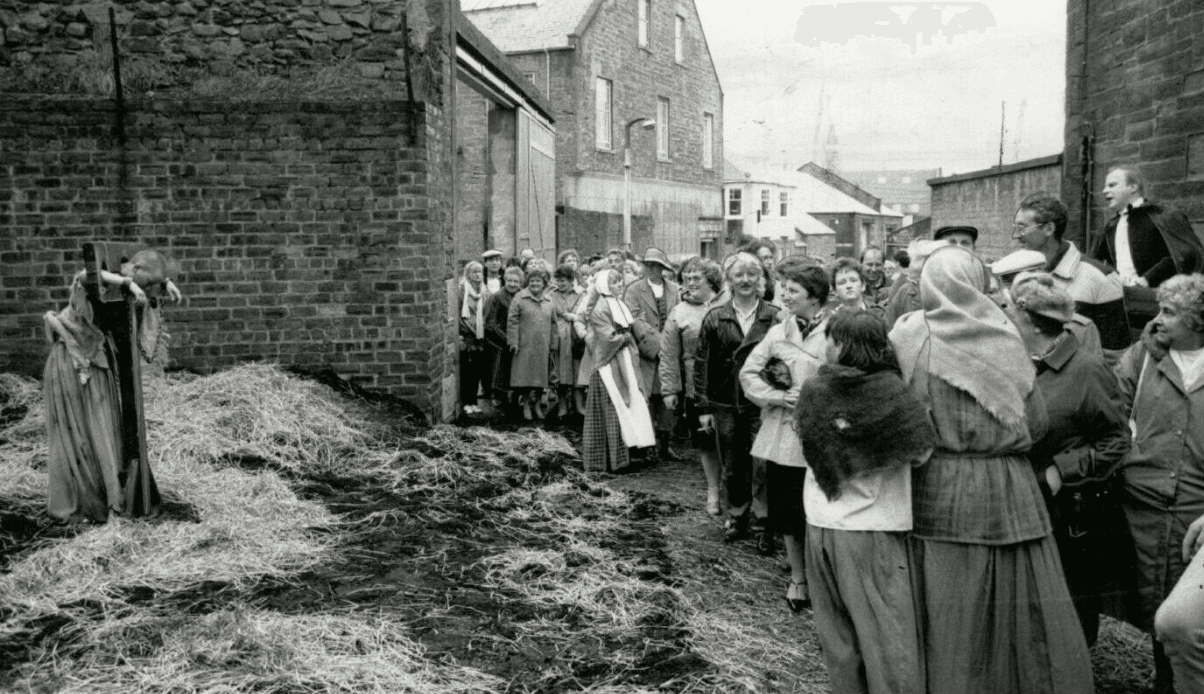
A witch in the stocks during the 1987 production of Witch’s Blood, Dundee. Image: DC Thomson, Dundee Courier.
Discussion with Artistic Director Alan Lyddiard and Dramaturg Duska Radosavljevic and students from Lunds University, published in the book Teaterpublicken & pubilkteatern by Lunds University
05 February 2026 (zoom) with Lund University, Sweden, Dramaturgy students
Alan Lyddiard is a British theatre and film director, a vocal advocate of the ensemble way of working and of community arts. He has been Associate Director at Dundee Rep (1984-1988), Artistic Director of TAG Glasgow (1988-1992) and of Northern Stage, Newcastle (1992-2005). Since 2014 he has been leading a company of performers aged 60+ called the Performance Ensemble, based in Leeds, and as of 2023 this has been a National Portfolio organisation in the United Kingdom, making Lyddiard the oldest professionally active Artistic Director in the country.
His most famous works as a director have included adaptations of Witch’s Blood (1987), Animal Farm1(1993), A Clockwork Orange (1999),1984 (2002), and Wings of Desire (2004). In the year 2000, Lyn Gardner noted in the Guardian that under Lyddiard’s inspired community-oriented leadership of Northern Stage, the theatre’s audiences rose by 20% (2000).
In this interview, conducted with the Dramaturgy students at Lund university, Lyddiard revisits some of his early works, key sources of inspiration and his ‘project model approach’ which evolved in the context of developing work as a form of co-creation and reciprocal exchange with the audience.
DUSKA There’s a threefold agenda to this conversation. The first level is collaboration – which the students in the room are currently exploring as their topic – and the ensemble way of working that has characterised your whole career. There’s also the notion of how you’ve bridged, in multiple ways, the gap that traditional mainstream theatre has created between what goes on on stage and what goes on in the auditorium and beyond. And then there’s the third level, which is your work with creative ageing more recently. I want to trace some of the ways in which you’ve developed your specific way of working by talking about particular examples. For a start, in summer 2025 The Courier newspaper in Dundee, Scotland, ran an article about your production of Witch’s Blood from 1987 which is still fondly remembered there, forty years on.
ALAN I’d like to say first of all that you’ve got to feel everything that you do personally. It’s a personal journey that you’re taking. Everybody is taking a different personal journey, and all my work has emerged from my personal feelings about a place I’ve gone to and learned to understand.
Arriving in Dundee in the ’70s felt like the end of the road. It was very deprived. There was a big strike on at the local factory. It felt very tired and dispirited. Dundee is a city in Scotland, on the East Coast. It’s cold, but very beautiful, set on the River Tay, and there’s something very magical about the River Tay and the journey from Fife into Dundee. It had a big effect on me. I started work at a theatre called Dundee Rep. I was actually barred from the restaurant on the first day because I looked too scruffy. It was a very slow process to get involved, but I was associate director there for about five years.
The thing that struck me most was that the theatre wasn’t really reflecting the lives of the people of Dundee. It was very much a traditional theatre presenting plays that had been seen in the West End of London – copies of old-fashioned plays. There were always French windows in the upstage corner, somebody would come in waving a tennis racket saying ‘anyone for tennis?”, there was a drinks cabinet and lots of people talking to each other in rather stifled ways.
I was very interested in this city I’d arrived in. It had an incredible effect on me, and I wanted to get to know it much more. So that’s what I did. I started getting to know a local singer-songwriter called Michael Marra, and he taught me that theatre is made with love and roots. That was his phrase: love and roots. He was a Dundonian who’d spent all his life in Dundee but had travelled the world as a singer-songwriter of great renown. It’s worth looking at his songs – Michael Marra – you’ll find stuff about him online.
Michael Marra took me to all the areas of Dundee that the theatre had never been to, all the schemes around the city centre – what you might call suburbs. They called them schemes, with many high-rise flats and desolate areas where people were living ordinary working-class lives. The theatre didn’t seem interested in those people. They were interested in the middle classes and traditional theatre-goers. Michael Marra convinced me that the people of Dundee in these schemes loved art as much as anybody else.
Together we started to create work, very slowly. I was the director, but Michael Marra was a Dundonian who knew their lives intimately and had worked with them for many years. They were families, communities he knew.
Having Michael with me allowed me to understand where those people were coming from and how inherently creative they were. We started slowly with Michael going into the community, gradually building songs with those people. Eventually we decided to adapt this well-known local book, Witch’s Blood, into a community project – 500 people ended up doing it. They were awarded Citizens of the Year by Dundee Ciry Council at the end, and I was asked immediately when we finished if we could do it again.
It made an incredible impact. The council suddenly realised that people from the schemes were creative. We made shows about Dundee with Dundee people creating work that was relevant to Dundee. That was the start of a moment in my life where I realised that’s what I needed to do, what I wanted to do wherever I was. I wanted to be with the people of that place, understand where I was living, and make art with those people who hadn’t necessarily been involved in artistic endeavours in the past. That was my starting point, and I loved it. Michael Marra telling me it’s all based on roots and love – it’s true.
You get to know people, their history, who they are, where they re coming from, and you start to fall in love with them. That’s how you make art.
DUSKA Going back a bit, you started your career as an actor. Before Dundee, you were in the Midlands working with very avant-garde theatre makers. There was quite a bit of movement in your career around different parts of the UK and different collaborators, different ways of working before you eventually set up your own ensemble company at Northern Stage in Newcastle.
ALAN I was an actor in a company in Loughborough called the Emma Theatre Company, and it was there I discovered dance. Everywhere you go, you discover something about the place. Next to the Emma Theatre Company was a dance company called Emma Dance Company. We were both small companies that toured around the East Midlands in England.
I was an actor who was just really prejudiced. I thought dance was stupid. I didn’t understand it. But suddenly I fell in love with dance and learned about it. I have worked with the choreographer Tamara McLorg for over 40 years now. Just that little sense of landing myself in a place where there happened to be a dance company next to us opened my eves to moving into a completely different area. I was an actor doing plays where people talk to each other a lot, and suddenly I was looking at dance.
That’s followed me right through to my work now. At the Performance Ensemble, our catchphrase after every project – there’s something called the project model approach in our work where everything is led by a project rather than a performance though performance is central to the project – we always have a tagline: Performance, Stories, Music, Dance, Life. Those five statements say this is who we are, this is what we do. We have stories, performance, music, dance, and we reflect life. All those elements are really integrated into every production, every project I do.
DUSKA Let’s talk about the project model approach a little bit – that is something that developed at Northern Stage as a way of working?
ALAN Yes, it is. The project model approach is really about finding the importance and relevance of the work you’re doing. You might have an idea to make a production called A Clockwork Orange. We did a production of A Clockwork Orange in the early 1990s when the Kubrick film was still banned. Anthony Burgess had had difficult experiences and didn’t allow the film to be shown in Britain.
We decided to do Clockwork Orange, and out of discussions around the idea emerged this question: is violence nature or nurture? Are you born being evil or do you learn to be evil? We had this idea that we should be looking at a whole range of different areas
‘deprived or depraved’ , ‘nature or nurture’. Are you deprived in order to become evil?
Let’s explore evil. So we arranged a range of research around that play, We went into prisons, we started working with young men about why they became violent, we looked at a whole range of different projects that surrounded the play.
The interesting thing about the project model approach is it’s a two-way traffic. The play is being offered to the community as a piece of work, but the ideas that surround the play are led into the play by talking to young people in prison or talking to different sides of that argument about evilness. We learned about what the play was about from others and showed what we were doing to others.
What’s emerged more recently, I think, in how you create theatre is this principle of co-creation. Co-creation at that early stage for me was the ‘project model approach – learning from others and sharing with others what you re doing. The whole principle of co-creation emerged for me out of that development. I had used it a lot in Dundee with every show we did, and I’m now using that project model approach in my current work at the Performance Ensemble.
DUSKA It seems like this is something that benefits from being in an institution r having those resources you had at the time when you were making work in either Dundee or Northern Stage, where you had the ensemble, you had time, and you were able to develop a project over a longer period.
ALAN Yes. I learned that from Lev Dodin. Lev Dodin made Lord of the Flies for his company in Saint Petersburg, and the whole company went and lived on an island for a month or two, where they were isolated and felt that sense of isolation and leadership emerging from it. I like that way of working.
Hence the ensemble – the idea of ensemble is that a group of people work together over an extended period of time, creating work slowly and building it slowly in order to give it more depth and more connections. I hated the British system of working where a group of actors would arrive from London, be together for three weeks, put on a show, then disappear back to London again and have no real contact with the people they were performing to.
I felt quite the opposite – that you needed to have that relationship with the people, a relationship with the place, and then you can start creating work that is meaningful and relevant.
DUSKA You just described the project model approach as being one where you’re developing a piece of work together with or by embedding yourself in the community and doing this research around the project itself. But there was also an important aspect of how the work is staged so that it carries a whole range of satellite projects around it.
ALAN Yes, correct. Some of the research led to projects in different areas of the community, and those projects would exist alongside the performance. This built audiences, built relationships, built a sense of we’re making this together. We’re not just doing a show on a stage, we’re actually relating that show to local people and finding out what local people were doing as an aspect of the production.
There would be a number of different satellite projects happening around the piece of theatre we were making in a theatre. Some of those projects came into the theatre and took over the theatre for a moment. But definatielty it was a two-way process- we were learning from them and they were learning from us, and we were sharing whatever we were doing together. That sense of building created audiences and relationships that were long-lasting and developed over years, rather than coming in, seeing the show and leaving.
DUSKA You mentioned Clockwork Orange as an example of a project model project in rems of how it was developed. Were there a number of satellite projects around it?
ALAN We did a film in a young offenders’ prison which was made by the young offenders themselves. They created the film. We did a conference called ‘Deprived or Depraved’ where we had experts on criminal law talking to us about the way young people are dealt with if they go down a particular path, the prison system.
We worked with the Probation Service, which supports people who have offended and ben in prison when they come out, trying to get them back into a less chaotic lifestyle.
We actually had probation officers attached to our theatre to develop the connection between young people – mostly young men – and the piece of theatre we were doing.
DUSKA I’m also thinking of 1984 and how when you decided to do 1984, the kids who were born in 1984 were turning 18, and you had a conference for 18-year-olds deciding how they were going to…
ALAN Yes, we exploited Big Brother in a way — the television series – because there’s a Big Brother in 1984 and there was currently a Big Brother on television where people were living together under surveillance cameras.
We had one of the people from Big Brother come to Newcastle and do an audience qustion-and-answer process about what it was like being in Big Brother. He was called Nay Nick, and he got chucked out of Big Brother because he didn’t play the game properly. In a way that’s what happens in 1984 – Winston Smith breaks the rules and is incarcerated and tortured, and his mind is changed by the end of the piece.
I was obsessed for a time with George Orwell, so I started by doing a project based on Animal Farm. I did a version of Animal Farm and borrowed an idea from Pina Bausch from her Rite of Spring. Pina Bausch did a version where the dancers performed on mud, and I thought that was a fantastic idea.
In Animal Farm, I covered the stage with mud and they performed on mud. In Animal Farm there’s this thing of ‘four legs good, two legs bad.’ I saw a photographic exhibition by a man called Duane Michals where he had people photographed with naked bodies but with boots on their hands – that gave us four legs. We made the piece with all the Performers with boots on their hands on mud, and it was fantastic. But I borrowed all the ideas from other people.
That’s the way you work, isn’t it? That’s the way you make work – you just see things that inspire you. that’s the crucial thing. Everything you do needs to have some sense of inspiration that you found in your heart that makes you do what you do. Pina Bausch is one of them, Duane Michals another one, Lev Dodin is one. These are all people I’ve admired over the years and learned from. You stand on the shoulders of giants – that’s how you create. You fall in love with people, and that’s how you create. It’s based on where you are and what you’re doing in a particular place. Love and roots – love and roots makes beautiful theatre.
DUSKA I was re-reading that interview I did with Lyn Gardner about your work the other day, and she was talking about several projects, but one I’m thinking of is Ballroom of Romance (Radosavljevic 2013). That project was also in this line of working with the community?
ALAN Yes. I’ve always believed that people are amazing. Everybody’s got a story to tell and everybody’s creative. I hold onto that deeply. I’ve gone off watching actors act. I don’t enjoy it anymore. It feels like what they’re doing is showing off – look at me, how good am I, how do I speak, look at my handsomeness, look at my way of being! It’s rubbish.
What I would much prefer is a real person on a stage being who they are completely and just express: I am here, this is me, I am fine, and I’m presenting myself to you.
Everybody is amazing. If you put somebody on a stage and shine a light on them, that in itself can be beautiful. If they do something like sing a song or do a play or play a musical instrument, that’s the bonus. The first most important thing is the person, the person being themselves in the moment. That’s my modus operandi now – I bring people together and just help them to present themselves in a really powerful way.
That started with Ballroom of Romance, where we had the ensemble working with many people all the time. They weren’t just acting on stage — they were never acting on stage.
I don’t like the phrase actor either. I like the word performer. They would have connections with community groups, go in and run workshops, and develop ideas with communities across Newcastle.
We set up a company called the Northern Stage Performance Company made up of local people who wanted to get involved in artistic endeavours. So we had the ensemble and we had the Performance Company, and I thought it was really important to put them together. We made a show called Ballroom of Romance, based on a short story by the Irish writer William Trevor – he’s a very famous short story writer, called the Irish Chekhov. I thought it would be a really good idea to bring our ensemble together – our permanent company of performers who as part of their learning process and skills development had formed a band, learned musical instruments – and bring the company of people from the community we called the Performance Company, together.
We made this piece called Ballroom of Romance, in which everybody was living the action for every moment. There was one particular woman who was a member of the ensemble who made sandwiches the whole show. That’s all she did – made sandwiches for the sandwich break in the dance hall. Then at one moment, she literally put her sandwiches down, walked to the very front of the stage, and stood there in front of the audience. She never said anything, but you could see she was thinking: I’m really fed up having to make sandwiches for six hours’ or whatever it is. She came to the front of the stage so people could see her and see that she was fed up, and they could relate to her in a way that was quite deep because it said a lot about her relationship with her husband, about her life, about who she was and how she felt about the world, just by standing in front of an audience for two minutes. We’d seen her throughout the piece making sandwiches for an hour and a half.
That kind of way of being is central to the work that I do, and it doesn’t matter if you’re a professional performer or a community performer – you can do that.
DUSKA Lyn also talked about how this was an unusual piece of theatre because it was bringing rural life on stage. She was saying theatre is always just about cities, city life, but this was different.
ALAN Yes, the ensemble went out to village halls around Northumberland, which is a very rural county in England, and created tea dance classes. We had tea dances in village halls. Because we’d just learned to be a band, we played at the tea dance. We organised a band playing at a tea dance, which was our ensemble, and we had somebody working with us from the local community that made the sandwiches. We created this idea of a tea dance in many places across Northumberland. All those people were the inspiration for the piece of work we were doing, which is based on a small little village where there’s a dance set up every Saturday. We lived it with communities before we did the piece of theatre.
We then created a system where we raised some money so we could get travel and subsidy so we could have buses that brought people from these little village halls into the city to see the show and take them home again after. By doing that process- applying the project model approach in a village hall around the area- we built and incredible audience.
There was a director who came to see it from Russia at the time, from Moscow – two very famous Moscow-based directors, one of them from Finland actually, originally from Finland but then living in Moscow. They came to see it, and at one moment in the middle of this performance made in a very localised way with local actors being local, these two Russian directors stood up in unison and clapped. It showed the kind of connection it can make nationally and internationally to what you’re doing…
DUSKA I want to come more to the present moment of the work you’re doing with creative ageing right now, but just before we get there, I’m thinking about one thing that really seems to me important to address across the cultural divide. You’re speaking in Sweden today, where there seems to be still a very stark division between what is professional theatre and what is amateur theatre. You have long left behind that particular division in your work. I just wonder, to what do you attribute this permission you’ve taken to just not worry about how you work with people, even though they’re not professionals? Where did that come from?
ALAN Well, it came from myself becoming older – I’m now 76, nearly 77. I retired but then decided I was bored being retired and wanted to come back and make theatre again. I decided I would work with people of my sort of age because I felt that it’s interesting as you get older, how you feel about life and art and everything. So why don’t I get together with a group of older people my sort of age and work with them to develop work?
I was inspired by two major things. One was Pina Bausch’s show Kontakthof, where she made a piece with her company and then made it again with local people in Wuppertal over the age of 70 who hadn’t ever performed in their lives before. It was a great success and an amazing show, and it inspired me.
The other person that inspired me was Yukio Ninagawa, a Japanese director very famous on the festival circuit across the world, making Shakespearean plays mostly, with a group of professional actors. He suddenly decided he didn’t want to do that anymore and wanted to see if he could work with people of his own age. He put an advert in the paper saying he was interested in working with older people. Thousands of people wrote back to him, and he chose 32 people to work with. He trained with them and talked with them for a year before he started making work for stages with them, and then that work toured the world.
In those two examples, I recognised myself. I could relate to them. So I thought, this is what I’m going to do. I’m going to make a piece of theatre with five professional performers and five non-professional performers – I call them ‘people from the community where I was living’ – and put them together to make a show called Anniversary.
It was basically the stories of their lives and how they were connected or not connected.
One of the professional performers, Villmore James, as a young boy saw another performer in the show, Namron, a professional dancer, in a theatre in Leeds and was inspired so much by him that he started a career in dance, and he eventually ends up on stage with him in a show 30 years later, working together. The reality of that and the way they were with each other was the material of the show. Other people had different relationships and experiences. It was a tremendous success, Anniversary.
DUSKA Which year was this?
ALAN It was performed in 2016, but it started work in 2014 – two years making it, a group of people on and off for two years. It was the story of their lives. It was performance, stories, music, dance, life-real life being shown on stage. We did it at Leeds Playhouse and it was very well received. As a result of that, I started to really form the company, and the company I now run, the Performance Ensemble, was formed out of that experience. We have now become a regularly funded organisation – the Arts Council has guaranteed funding until March 2028.
From that two-year practice of working at Leeds Playhouse with their community of older people who met every Friday or Wednesday, bringing a group of professional performers I’d worked with over many years, putting them together, creating a show together made by them and then presented – that was the start of my journey to where I am now.
DUSKA Okay, that’s great! Let’s open it out now in case people have some questions.
STUDENT: It’s very interesting – but what’s the toughest part in working with both professionals and non-professionals?
ALAN Hardest part? Well, there isn’t a hard part actually. You just have to choose the right people, and that’s important. First, I chose five people that I knew very well, who I’d worked with over many years. That’s another thing that’s important – longevity.
Working with people again and again really does make for a deeper, richer experience at the end of the day.
Then, I had been working at Leeds Playhouse with this community group. I did audition – this is the first time I auditioned non-professional but I kind of knew them too and had worked with them for at least a year on and off. We spent a lot of time together socially.
The ten people would have lunch together. We’d always try to create a situation where people were going out after a rehearsal and chatting. There was very much a social gathering feel about it, because actually that’s what the piece was about. It was about ten people making a dance piece together, and in the process of making a dance piece, they told the audience about their lives. But we lived it. We lived it.
I believe totally in ensemble. Ensemble is an incredibly beautiful way of working. It means you’re working together – you have to have boundaries, you have to go home at night and have your own life – but the principal idea of being together, working together, eating together, discussing, going to see a show together, discussing how you are in life and what it’s like to grow old together – all these things are really crucial to the creation of the art that you’re making.
Join our mailing list for updates,
show dates and opportunities.